Stew Series
Korean Stew Guide
Three completely different stews — all deeply Korean, all made with Walmart ingredients. 찌개 (jjigae) is Korea's soul food: a bubbling pot that has fed families for centuries.
🇰🇷 Why Every Korean Meal Has a Jjigae
In Korean dining culture, 찌개 is not a main dish — it is the warm center of the table. Every shared meal (밥상) includes rice, side dishes (반찬), and a communal jjigae pot. In K-dramas, a character making jjigae for someone is almost always a love language.
Quick Comparison
| Stew | Umami | Heat |
|---|---|---|
| Doenjang Jjigae (된장찌개) Joseon Dynasty (15th century) | 🟤🟤🟤🟤🟤 | 🌶️🌶️🌶️🌶️🌶️ |
| Sundubu Jjigae (순두부찌개) Popularized in the 1980s | 🟤🟤🟤🟤🟤 | 🌶️🌶️🌶️🌶️🌶️ |
| Budae Jjigae (부대찌개) Post-Korean War (1950s) — US military base surplus ingredients | 🟤🟤🟤🟤🟤 | 🌶️🌶️🌶️🌶️🌶️ |

Doenjang Jjigae (된장찌개)
Mom's kitchen — deep, earthy, forever
Umami depth
Heat
Comfort
Time
⏱ 25 min
Origin
Joseon Dynasty (15th century), Korea's oldest stew
K-Drama Scene
Crash Landing on You — Ri Jung-hyeok cooks it for Yoon Se-ri, a rare moment of vulnerability
🇰🇷 K-Culture Tip
된장 is Korea's version of miso, but older and deeper-fermented. Korean grandmothers traditionally fermented it in clay pots (항아리) buried underground over winter. There's a Korean saying: '된장찌개 냄새가 집 냄새' — the smell of doenjang jjigae is the smell of home. In Crash Landing on You, the North Korean village women introducing Se-ri to this stew is a scene of genuine cultural warmth.

Sundubu Jjigae (순두부찌개)
Fiery but silky — the hug that burns
Umami depth
Heat
Comfort
Time
⏱ 20 min
Origin
Popularized in the 1980s, now a Korean restaurant staple
K-Drama Scene
Ordered in almost every K-drama breakfast scene — especially in medical and office dramas
🇰🇷 K-Culture Tip
순두부찌개 is traditionally served in an 뚝배기 (earthenware pot) that retains heat — the dish arrives at your table literally boiling and keeps cooking as you eat. Breaking a raw egg into the stew at the table is part of the ritual. Soft tofu has a 2,000-year history in Korea, first served in Buddhist temples long before the spicy version existed.
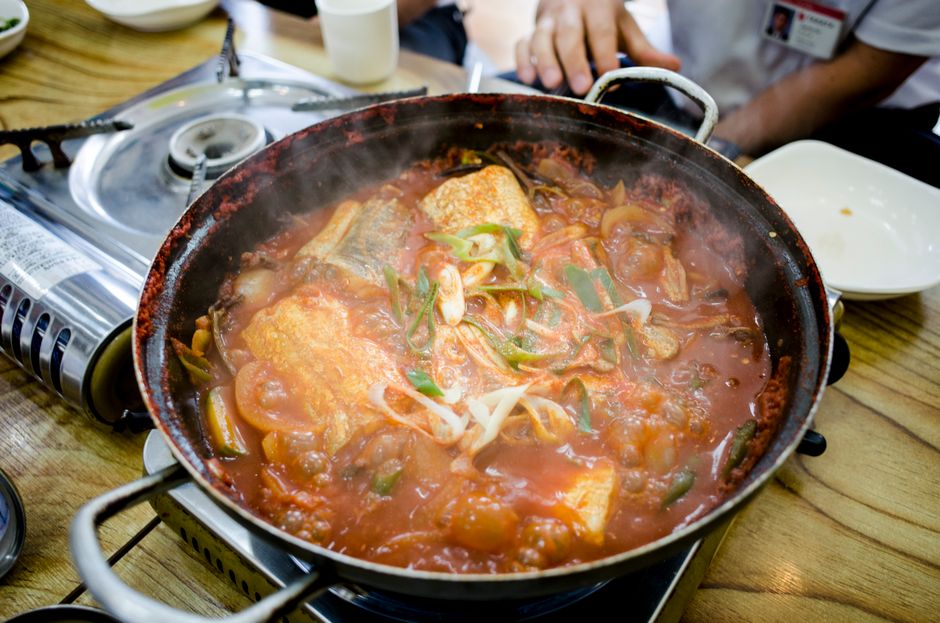
Budae Jjigae (부대찌개)
Chaotic, nostalgic, proudly impure fusion
Umami depth
Heat
Comfort
Time
⏱ 30 min
Origin
Post-Korean War (1950s) — US military base surplus ingredients
K-Drama Scene
Reply 1988 — neighbourhood families sharing one big bubbling pot at the communal table
🇰🇷 K-Culture Tip
부대찌개 was born near US military bases after the Korean War, when Koreans creatively combined surplus American rations (SPAM, hot dogs, baked beans) with Korean flavors. Today it carries zero stigma — it's a beloved comfort food, a symbol of Korean resilience, and proof that you can make something extraordinary from whatever you have.